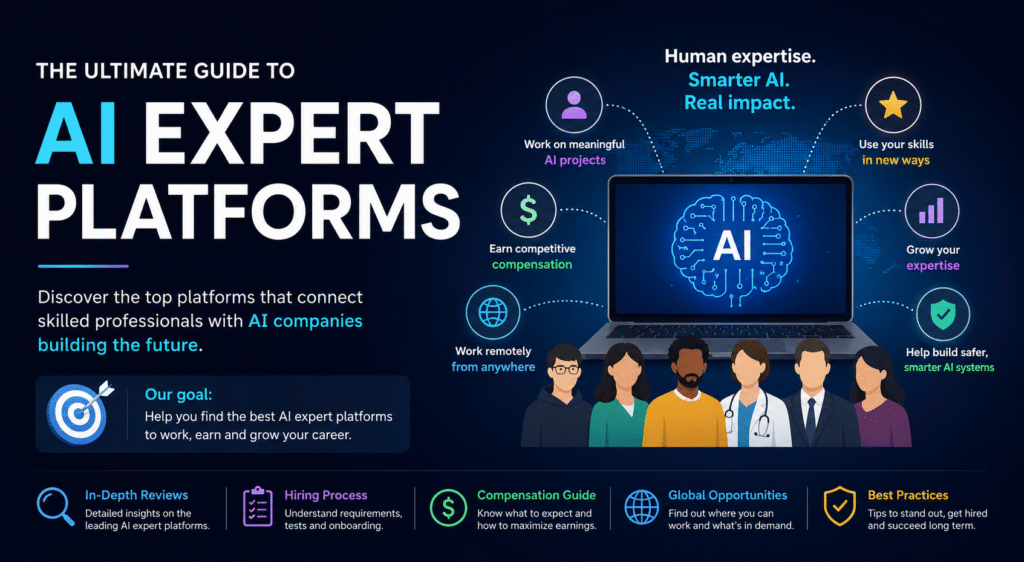
Artificial Intelligence is transforming the way software is built, but it’s also creating an entirely new labor market.
Behind every advanced AI model are thousands of human experts reviewing responses, solving complex problems, validating facts, and helping systems become more accurate. From software engineers and data scientists to lawyers, physicians, accountants, marketers and linguists, professionals across nearly every industry are now contributing to the development of AI.
This growing ecosystem has given rise to a new category of companies: AI Expert Platforms. Rather than hiring large in-house teams, many AI organizations rely on specialized platforms to recruit, assess and manage global networks of experts who work remotely on AI training, evaluation and quality improvement projects.
For professionals, this represents a new kind of opportunity. Unlike traditional freelancing, AI expert work focuses on applying existing professional knowledge to improve artificial intelligence systems. Projects are often flexible, remote, and matched to your expertise instead of requiring you to find clients or pitch for work.
But with dozens of platforms now operating in this space, choosing where to apply can be confusing. Each platform has its own application process, eligibility requirements, compensation model and areas of specialization. Some focus on software engineering, others recruit domain experts in medicine, law or finance, while a growing number seek multilingual professionals and researchers.
This guide brings everything together in one place. You’ll learn how the AI workforce ecosystem works, compare the leading AI expert platforms, understand how professionals are hired, explore compensation trends, discover which skills are currently in demand, and find out which platforms best match your background.
Whether you’re exploring AI work for the first time or looking to expand your professional opportunities, this guide will help you navigate one of the fastest-growing segments of the global technology economy.
What Are AI Expert Platforms?
Artificial Intelligence is often associated with algorithms, automation and large language models. However, one of the biggest forces behind modern AI isn’t artificial at all, it’s human expertise.
AI expert platforms are specialized marketplaces that connect qualified professionals with companies developing artificial intelligence systems. These platforms recruit, assess and manage experts who help train, evaluate and improve AI models through real-world knowledge and professional judgment.
Instead of building software for clients or competing for freelance projects, experts contribute directly to the development of AI by reviewing responses, solving complex problems, validating information and providing structured feedback that helps models become more accurate, reliable and useful.
As AI adoption accelerates across industries, these platforms have become an essential part of the AI ecosystem, enabling companies to access thousands of specialists worldwide without maintaining large in-house teams.
How AI Expert Platforms Work
The workflow is surprisingly straightforward.
Rather than applying directly to an AI company, professionals typically join an intermediary platform that manages recruitment, assessments, payments and project allocation.
The process generally follows these steps:
- Application – Create a profile and submit your professional background.
- Assessment – Complete technical, language or domain-specific evaluations.
- Verification – Confirm your education, work experience or professional credentials when required.
- Project Matching – The platform matches your expertise with suitable AI projects.
- Paid Work – Complete tasks remotely and receive payment according to the platform’s compensation model.
This approach allows AI companies to scale rapidly while ensuring projects are handled by professionals with the appropriate expertise.
AI Expert Platforms vs Traditional Freelancing
Although both involve remote work, AI expert platforms operate very differently from traditional freelance marketplaces like Upwork or Fiverr.
| Traditional Freelancing | AI Expert Platforms |
|---|---|
| You search for clients | The platform matches you with projects |
| You submit proposals | You complete qualification assessments |
| You negotiate rates | Compensation is generally predefined |
| You manage client relationships | Most communication happens through the platform |
| Every project is unique | Tasks often follow standardized evaluation workflows |
| Success depends on sales skills | Success depends primarily on professional expertise |
For many professionals, this removes one of the biggest challenges of freelancing: constantly finding new clients.
Why AI Companies Need Human Experts
Artificial Intelligence has reached remarkable levels of capability. Modern large language models can write essays, generate code, summarize research papers and answer complex questions in seconds.
Yet despite these advances, every leading AI company, including those behind today’s most advanced models, continues to invest heavily in human expertise.
The reason is simple:
AI learns from data, but it improves through human judgment.
No matter how sophisticated a model becomes, it still lacks real-world experience, professional accountability and the nuanced decision-making that experts develop over years of practice.
Human specialists remain essential for evaluating outputs, identifying mistakes and teaching AI systems how to reason more accurately across specialized domains.
AI Models Are Prediction Engines, Not Expert
One of the biggest misconceptions about artificial intelligence is that it “knows” things in the same way humans do.
In reality, most modern language models are sophisticated prediction systems.
Their primary objective is to generate the most probable next word, sentence or sequence based on patterns learned during training.
While this approach produces remarkably natural responses, it also creates important limitations.
AI models can:
- produce convincing but incorrect answers;
- fabricate references or citations;
- misunderstand professional standards;
- misinterpret complex regulations;
- struggle with uncommon scenarios;
- confidently present inaccurate information.
These errors are commonly known as hallucinations, but they represent only one category of limitation.
Even when an answer appears correct, it may still be incomplete, poorly reasoned or fail to meet the expectations of a professional working in that field.
Why Human Judgment Cannot Be Replaced
Many professional decisions require more than factual knowledge.
- They require context.
- Judgment.
- Experience.
- Ethics.
- Risk assessment.
Consider the following examples:
Healthcare
A language model may generate a medically plausible answer.
A physician evaluates whether the recommendation:
- follows current clinical guidelines;
- considers contraindications;
- prioritizes patient safety;
- reflects real-world medical practice.
Law
An AI system may summarize legislation correctly while overlooking jurisdiction-specific rules or recent legal precedents.
A lawyer determines whether the reasoning is legally sound—not merely grammatically correct.
Software Engineering
An AI-generated solution may compile successfully while introducing security vulnerabilities, unnecessary complexity or poor architectural decisions.
An experienced software engineer evaluates code quality, maintainability and long-term reliability.
Finance
A financial model may calculate numbers accurately while making unrealistic assumptions about risk, taxation or regulation.
Financial professionals assess whether the reasoning reflects actual market conditions and regulatory frameworks.
These examples demonstrate why domain expertise remains indispensable throughout AI development.
Human Feedback Is the Engine Behind Better AI
Every improvement made to modern AI models depends on large volumes of high-quality human feedback.
Experts continuously review AI outputs to determine whether responses are:
- factually accurate;
- logically consistent;
- complete;
- relevant;
- safe;
- unbiased;
- professionally acceptable.
Their evaluations become training signals that help future versions of AI produce better results.
Without this feedback loop, model quality would quickly plateau.
Human-in-the-Loop AI
Most commercial AI systems operate using a concept known as Human-in-the-Loop (HITL).
Rather than allowing models to learn entirely on their own, humans remain involved throughout the development lifecycle.
A simplified workflow looks like this:
Large Language Model
          ↓
Generates Response
          ↓
Human Expert Reviews
          ↓
Feedback & Corrections
          ↓
Training Dataset Improves
          ↓
Better Future Models
Human experts do not simply “correct mistakes.”
They teach models what constitutes a better answer.
This distinction is fundamental.
What Human Experts Actually Do
When people hear about AI training, they often imagine repetitive tasks such as labeling images or categorizing text. While these activities remain part of machine learning workflows, the work performed by today’s AI experts is significantly more sophisticated.
Modern foundation models are expected to reason, write code, analyze financial statements, explain scientific concepts, interpret legal documents and assist with medical information. Achieving this level of capability requires continuous evaluation by professionals who understand these subjects at a level that AI alone cannot replicate.
Human experts are responsible for identifying subtle errors, evaluating reasoning quality and providing structured feedback that guides future model improvements. Rather than simply marking answers as “correct” or “incorrect,” they assess how well an AI system thinks, communicates and applies knowledge within a specific domain.
Depending on the project, this work may involve analytical reasoning, technical validation, quality assurance, safety evaluation or preference ranking.
Response Evaluation and Preference Ranking
One of the most common tasks involves comparing multiple AI-generated responses to the same prompt.
Rather than determining whether an answer is merely correct, experts evaluate which response demonstrates superior reasoning, factual accuracy and overall usefulness.
A typical evaluation considers factors such as:
- factual correctness;
- logical consistency;
- completeness;
- clarity and organization;
- instruction following;
- relevance to the prompt;
- tone and readability;
- safety and policy compliance.
For example, two responses may both reach the correct conclusion, but one may provide stronger reasoning, better evidence and clearer explanations. Human evaluators identify these qualitative differences and rank responses accordingly.
These preference rankings become valuable training signals that help optimize future versions of the model.
Domain-Specific Validation
General-purpose knowledge is not sufficient when AI is deployed in specialized industries.
Many projects require professionals with formal education or industry experience to verify whether AI-generated outputs meet the standards expected within their discipline.
Because these evaluations require specialized judgment, they cannot be reliably automated using general-purpose models alone.
Code Review and Software Evaluation
Software engineering projects extend far beyond asking an AI model to write code.
Human reviewers evaluate whether generated software is:
- syntactically correct;
- functionally accurate;
- computationally efficient;
- secure;
- maintainable;
- scalable;
- aligned with accepted development practices.
Rather than focusing exclusively on whether code executes successfully, reviewers examine architectural decisions, algorithm selection, documentation quality, test coverage and potential security vulnerabilities.
In many cases, experts compare multiple implementations and explain why one solution is technically superior.
Hallucination Detection and Fact Verification
Large language models occasionally generate information that appears convincing but is inaccurate or entirely fabricated.
Experts review AI outputs to identify:
- invented facts;
- fabricated citations;
- nonexistent legislation;
- imaginary research papers;
- incorrect statistics;
- outdated recommendations;
- unsupported claims.
When inaccuracies are found, reviewers provide structured feedback explaining why the information is incorrect and, where applicable, identify authoritative alternatives.
Improving factual reliability remains one of the highest priorities across the AI industry.
Prompt Design and Adversarial Testing
Human experts also help improve AI by designing prompts that intentionally expose weaknesses.
These prompts may test the model’s ability to:
- follow complex instructions;
- solve multi-step problems;
- handle ambiguous requests;
- resist prompt injection attempts;
- maintain consistency over long conversations;
- explain difficult concepts;
- recognize uncertainty;
- avoid unsafe outputs.
This process, often called adversarial testing or red teaming, helps developers discover failure modes before models are released to users.
Safety and Alignment Evaluation
Technical accuracy alone is not enough. AI systems must also behave safely and responsibly.
Specialized reviewers evaluate whether responses:
- contain harmful advice;
- reinforce dangerous misinformation;
- promote illegal activities;
- exhibit discriminatory bias;
- violate privacy expectations;
- encourage unsafe behavior;
- produce inappropriate content.
These evaluations contribute to model alignment—the process of ensuring that AI systems behave consistently with human expectations, ethical principles and platform policies.
Data Quality Improvement
The quality of an AI model depends heavily on the quality of the data used during training and evaluation.
Experts therefore review datasets to:
- identify annotation errors;
- remove duplicate examples;
- detect inconsistencies;
- improve labeling guidelines;
- verify metadata accuracy;
- ensure representative coverage across domains.
High-quality datasets reduce noise during training and improve overall model performance.
Continuous Feedback Loops
AI development is not a one-time process.
Once a model is deployed, human experts continue monitoring its performance through iterative evaluation cycles.
These feedback loops allow organizations to:
- measure improvements between model versions;
- identify newly emerging failure patterns;
- benchmark competing models;
- validate updates before deployment;
- prioritize future training objectives.
This continuous evaluation process enables AI systems to evolve over time rather than remaining static after their initial release.
Collaboration Across Disciplines
One of the defining characteristics of modern AI development is that it brings together experts from many different fields.
A single project may involve:
| Professional | Primary Contribution |
|---|---|
| Software Engineers | Code generation, debugging, architecture review |
| Data Scientists | Statistical reasoning and model evaluation |
| Physicians | Clinical accuracy and patient safety |
| Lawyers | Legal reasoning and regulatory interpretation |
| Financial Analysts | Accounting, valuation and risk analysis |
| Mathematicians | Proof validation and quantitative reasoning |
| Linguists | Translation quality, localization and multilingual evaluation |
| Educators | Pedagogical quality and instructional clarity |
| Cybersecurity Specialists | Vulnerability detection and secure coding |
| UX Writers | Communication quality and user comprehension |
This multidisciplinary collaboration enables AI systems to perform effectively across increasingly complex real-world scenarios.
From Reviewers to AI Trainers
Perhaps the most important distinction is that human experts are not simply reviewing AI-generated content—they are shaping the future behavior of AI systems.
Every evaluation, preference ranking, correction and explanation contributes to a feedback process that influences how future models respond to similar problems.
In this sense, AI experts function less as quality inspectors and more as teachers. They help transform raw predictive models into systems that reason more effectively, communicate more clearly and perform more reliably across professional domains.
As AI capabilities continue to expand, the role of human experts is evolving from reviewing outputs to actively guiding the development of increasingly capable and trustworthy intelligent systems.
Types of AI Jobs (Remote AI Expert Jobs)
The AI industry has created thousands of remote opportunities for professionals whose expertise extends far beyond artificial intelligence itself.
While software engineering remains one of the largest hiring categories, AI companies increasingly recruit specialists in healthcare, law, finance, education, science, marketing and dozens of other disciplines.
This reflects a fundamental shift in how modern AI systems are developed.
Instead of relying exclusively on machine learning engineers, today’s leading AI companies depend on professionals who understand how knowledge is applied in the real world.
Whether reviewing AI-generated legal arguments, validating medical recommendations or evaluating financial analyses, these experts help ensure that AI systems become more accurate, reliable and trustworthy.
The exact nature of the work varies by platform and project, but most AI expert roles fall into several broad categories.
1. AI Response Evaluator
Perhaps the most common role across AI expert platforms is the AI Response Evaluator.
These professionals assess AI-generated responses and determine how well they satisfy a user’s request.
Unlike traditional quality assurance, the goal is not simply to identify mistakes.
Evaluators compare responses based on multiple dimensions, including:
- factual accuracy;
- logical reasoning;
- completeness;
- helpfulness;
- writing quality;
- instruction following;
- safety;
- consistency.
A typical task may involve comparing two or more responses to the same prompt and selecting the strongest one while providing a detailed justification.
Typical Skills
- Critical thinking
- Analytical reasoning
- Written communication
- Attention to detail
- Domain expertise (depending on the project)
Typical Backgrounds
- Teachers
- Writers
- Researchers
- Consultants
- Analysts
- Graduate students
- Subject matter experts
2. Prompt Engineer
Prompt Engineers design prompts that challenge AI systems and expose weaknesses.
Contrary to popular belief, professional prompt engineering involves much more than writing clever instructions.
Projects often require creating prompts that:
- evaluate reasoning;
- test factual knowledge;
- expose hallucinations;
- assess mathematical ability;
- measure coding performance;
- verify instruction following.
High-quality prompts help companies benchmark model performance and identify areas for improvement.
Typical Tasks
- Design evaluation prompts
- Create benchmark datasets
- Develop reasoning scenarios
- Test model consistency
- Build multilingual prompts
3. AI Coding Expert
Coding remains one of the highest-demand categories.
Software engineers help evaluate code generation models by reviewing AI-written software and solving programming challenges.
Tasks frequently include:
- debugging;
- algorithm evaluation;
- code comparison;
- architecture review;
- security analysis;
- documentation review;
- performance optimization.
Programming languages commonly requested include:
- Python
- JavaScript
- TypeScript
- Java
- C++
- Go
- Rust
- SQL
Many projects also involve reviewing multiple implementations and explaining which solution demonstrates better engineering practices.
4. Mathematics & Reasoning Expert
Reasoning has become one of the largest investment areas for frontier AI models.
Mathematics experts evaluate whether models correctly solve problems involving:
- algebra;
- calculus;
- statistics;
- probability;
- geometry;
- optimization;
- mathematical proofs.
Unlike automated grading, reviewers analyze the reasoning process—not just the final answer.
These projects are particularly common for professionals with degrees in mathematics, physics, engineering or computer science.
5. Medical AI Expert
Healthcare remains one of the fastest-growing domains for AI evaluation.
Medical experts review AI-generated information for:
- diagnostic reasoning;
- treatment recommendations;
- pharmacology;
- anatomy;
- pathology;
- clinical guidelines;
- patient safety.
Because incorrect medical advice can have serious consequences, these projects generally require licensed professionals or individuals with advanced medical education.
Typical backgrounds include:
- Physicians
- Nurses
- Pharmacists
- Dentists
- Medical Researchers
6. Legal AI Expert
Legal language is highly specialized and jurisdiction dependent.
AI companies therefore recruit lawyers and legal professionals to evaluate:
- contracts;
- legislation;
- legal reasoning;
- compliance;
- regulatory interpretation;
- legal research;
- case summaries.
Projects often require identifying subtle inaccuracies that only experienced legal professionals can recognize.
7. Financial AI Expert
Finance professionals help AI systems understand complex economic and financial concepts.
Typical projects include evaluating:
- investment analysis;
- accounting principles;
- financial modeling;
- taxation;
- auditing;
- risk assessment;
- banking regulations.
Professionals with experience in corporate finance, accounting, consulting or investment management are frequently recruited.
8. Language & Linguistics Expert
Multilingual AI models require continuous evaluation across hundreds of languages.
Language specialists help improve:
- grammar;
- fluency;
- translation quality;
- localization;
- cultural adaptation;
- terminology consistency.
Tasks often include comparing translations, reviewing multilingual conversations and identifying subtle linguistic errors.
This category has expanded rapidly as AI systems become increasingly multilingual.
9. Scientific Research Expert
Researchers contribute specialized knowledge across disciplines such as:
- biology;
- chemistry;
- physics;
- environmental science;
- psychology;
- neuroscience.
Their work may involve validating scientific explanations, reviewing technical terminology or assessing whether AI correctly interprets academic literature.
10. Data Analysis Expert
Many organizations recruit analysts to evaluate how AI performs with structured information.
Tasks include:
- interpreting datasets;
- identifying trends;
- explaining statistical findings;
- reviewing dashboards;
- validating business insights.
Professionals familiar with Excel, SQL, Python, Power BI or Tableau often qualify for these projects.
11. Marketing & Business Expert
As AI becomes integrated into business workflows, companies increasingly recruit professionals with commercial experience.
Projects may involve evaluating AI-generated:
- marketing strategies;
- SEO recommendations;
- advertising copy;
- sales messaging;
- customer segmentation;
- product positioning;
- business case analyses.
Professionals with experience in digital marketing, product management, consulting and growth strategy are commonly recruited.
12. AI Safety & Alignment Specialist
Some of the most advanced projects focus on AI safety.
These specialists evaluate whether models:
- produce harmful advice;
- reinforce bias;
- violate privacy;
- encourage illegal activities;
- generate unsafe instructions.
Their feedback contributes directly to safer AI deployment.
Which Role Is Right for You?
The best AI expert role depends largely on your professional background rather than your experience with artificial intelligence.
| Your Background | Recommended AI Roles |
|---|---|
| Software Engineer | Coding Expert, Code Reviewer, AI Evaluator |
| Data Analyst | Data Analysis Expert, Response Evaluator |
| Data Scientist | Reasoning Expert, AI Evaluator |
| Lawyer | Legal AI Expert |
| Doctor | Medical AI Expert |
| Accountant | Financial AI Expert |
| Teacher | Response Evaluator, Education Expert |
| Marketing Professional | Marketing AI Expert |
| Translator | Linguistics Expert |
| Researcher | Scientific Expert |
The Future of AI Expert Work
As AI systems become increasingly capable, the demand for human expertise is shifting from repetitive annotation toward high-value cognitive work.
Rather than performing simple labeling tasks, today’s experts evaluate reasoning, assess professional judgment, verify factual accuracy and help define what “good” AI looks like.
This evolution is creating a new category of knowledge work where years of professional experience become a competitive advantage in the development of artificial intelligence.
For professionals willing to apply their expertise in new ways, AI expert platforms represent one of the fastest-growing remote work opportunities in the global technology sector.
Best AI Expert Platforms
The rapid growth of generative AI has led to the emergence of a new category of companies dedicated to sourcing, assessing and managing expert talent for AI development.
Rather than hiring thousands of specialists directly, many AI organizations partner with specialized platforms that recruit professionals from around the world. These platforms handle everything from candidate screening and skills assessments to project matching, payments and ongoing workforce management.
Although they all operate within the AI ecosystem, their focus varies considerably. Some specialize in software engineering, while others recruit professionals in medicine, finance, law, education, science and multilingual communication.
Understanding these differences is essential before deciding where to apply.
Below is an overview of some of the leading AI expert platforms available today.
At a Glance
| Platform | Primary Focus | Best For | Experience Level | Remote | Contractor |
|---|---|---|---|---|---|
| Outlier | AI Training & Evaluation | General Experts | Mid–Senior | ✅ | ✅ |
| Mercor | AI Recruiting | Technical & Business | Mid–Senior | ✅ | ✅ |
| Alignerr | AI Data & Domain Experts | Specialists | Mid–Senior | ✅ | ✅ |
| Micro1 | AI Talent Marketplace | Engineers | Senior | ✅ | ✅ |
| Turing | Software Engineering | Developers | Mid–Senior | ✅ | ✅ |
| Scale AI | AI Data & RLHF | Technical Experts | Mixed | ✅ | ✅ |
| Invisible Technologies | AI Operations | Operations & Analysts | Mixed | ✅ | ✅ |
1. Outlier
Overview
Outlier is one of the best-known AI expert platforms and focuses on improving large language models through human evaluation.
Professionals work on projects that help AI systems become more accurate, safer and more capable across a wide range of domains.
Unlike traditional freelancing platforms, Outlier generally assigns work after candidates complete assessments and qualify for specific projects.
Because projects change frequently, the availability of work may vary depending on demand, language, expertise and geographic location.
Typical Projects
Experts may be asked to:
- compare AI responses;
- evaluate reasoning quality;
- write prompts;
- identify factual inaccuracies;
- review coding solutions;
- perform multilingual evaluations;
- improve AI-generated content.
Who Should Apply?
Outlier regularly recruits professionals from areas including:
- Software Engineering
- Data Science
- Mathematics
- Law
- Medicine
- Finance
- Marketing
- Linguistics
- Education
- Scientific Research
Advantages
✔ Flexible remote work
✔ Wide range of professional backgrounds
✔ Frequent new projects
✔ Global hiring
✔ Opportunity to contribute to frontier AI models
Potential Challenges
- Project availability fluctuates.
- Qualification assessments may be demanding.
- Contractors may experience periods without active work.
- Different projects may have different payment structures.
Best For
Professionals looking for flexible AI evaluation work across multiple disciplines.
Read our complete Outlier Review →
2. Mercor
Overview
Mercor combines AI-powered recruiting with talent matching.
Instead of functioning purely as an annotation platform, Mercor aims to identify highly qualified professionals and connect them with AI companies seeking specialized expertise.
The company uses AI throughout its recruitment process, including candidate evaluation and interview scheduling.
Typical Projects
Projects often involve:
- software development;
- AI engineering;
- product management;
- consulting;
- data analysis;
- business operations.
Hiring Process
Applicants typically complete:
- profile creation;
- resume review;
- AI interview;
- technical assessment;
- client matching.
Best For
Experienced professionals seeking longer-term contractor opportunities rather than short evaluation tasks.
Advantages
- Professional recruiting process
- High-skilled opportunities
- Global remote hiring
- Strong focus on experienced talent
Considerations
Hiring standards are generally higher than on traditional freelance platforms.
Read the full Mercor Review →
3. Alignerr
Overview
Alignerr specializes in recruiting domain experts who help improve AI systems through evaluation, verification and subject-matter expertise.
The platform emphasizes high-quality professional knowledge rather than general freelance work.
Typical Work
Projects may include:
- response evaluation;
- scientific review;
- legal validation;
- multilingual evaluation;
- prompt writing;
- reasoning analysis.
Best Backgrounds
- Lawyers
- Doctors
- Researchers
- Engineers
- Analysts
- Teachers
Strengths
- Strong emphasis on professional expertise
- Variety of academic disciplines
- Flexible remote projects
Read the full Alignerr Review →
4. Micro1
Overview
Micro1 focuses primarily on technical talent.
The platform recruits experienced software engineers for AI companies and technology startups.
Unlike many AI evaluation platforms, Micro1 often resembles an AI-powered recruiting agency.
Typical Roles
- Software Engineer
- Full Stack Developer
- Backend Engineer
- Frontend Engineer
- Machine Learning Engineer
- DevOps Engineer
Recruitment Process
Candidates generally complete:
- profile review;
- coding assessments;
- interviews;
- technical verification;
- client matching.
Best For
Senior software engineers seeking remote contracts.
Advantages
- Strong engineering focus
- High-quality clients
- Global remote work
- Referral opportunities
Read the complete Micro1 Review →
5. Turing
Overview
Turing connects software developers with companies looking for remote engineering talent.
Although it predates the recent AI boom, the platform now supports many AI-related hiring initiatives, particularly for software engineering and AI infrastructure.
Typical Positions
- Backend Engineering
- Frontend Engineering
- Full Stack Development
- AI Engineering
- Data Engineering
Best For
Developers seeking long-term remote contracts.
6. Scale AI
Overview
Scale AI plays a major role in supplying data infrastructure and expert feedback for artificial intelligence development.
Depending on the project, professionals may contribute through:
- RLHF projects;
- response evaluation;
- coding;
- mathematics;
- scientific reasoning;
- multilingual evaluation.
Best For
Technical professionals interested in model training and evaluation.
7. Invisible Technologies
Overview
Invisible Technologies combines AI with human operations.
Rather than focusing exclusively on AI evaluation, the company supports organizations by integrating automation with expert human oversight.
Projects often include:
- business process review;
- quality assurance;
- AI operations;
- workflow optimization;
- data validation.
Best For
Professionals with analytical, operational or business process experience.
How to Choose the Right Platform
Not every platform is designed for the same type of professional.
Before applying, consider the following factors.
Your Professional Background
Some platforms prioritize software engineers, while others actively recruit specialists in medicine, law, finance or education.
Choose platforms that regularly publish projects aligned with your expertise.
Type of Work
Ask yourself what kind of projects you enjoy most.
Would you rather:
- review AI responses;
- solve programming problems;
- write prompts;
- analyze legal documents;
- evaluate medical information;
- review financial analyses;
- perform multilingual tasks?
Different platforms emphasize different workflows.
Project Availability
Work availability can fluctuate based on client demand, geographic location and your qualifications.
Joining multiple platforms may increase your chances of finding consistent opportunities.
Compensation Model
Some platforms pay:
- hourly;
- per task;
- per completed project;
- through fixed contractor agreements.
Understanding how compensation is structured can help set realistic expectations.
Geographic Eligibility
Not every platform hires in every country.
Before investing time in assessments, verify that your country of residence is supported and that you meet any applicable tax or legal requirements.
Comparison Summary
Although every platform contributes to the broader AI workforce ecosystem, each serves a different purpose.
- Outlier excels in AI evaluation across many disciplines.
- Mercor focuses on matching experienced professionals with AI companies.
- Micro1 is particularly strong for senior software engineers.
- Alignerr emphasizes subject-matter expertise and domain knowledge.
- Scale AI plays a significant role in AI training and evaluation infrastructure.
- Turing specializes in remote software engineering opportunities.
- Invisible Technologies blends AI operations with human expertise.
Rather than choosing a single platform, many professionals maintain profiles on multiple services to maximize access to projects and diversify their opportunities within the rapidly expanding AI expert economy.
Compensation: How Much Do AI Expert Platforms Pay?
One of the most common questions professionals ask before joining an AI expert platform is:
“How much can I earn?”
The answer is more nuanced than a single hourly rate.
Unlike traditional employment, AI expert platforms use a variety of compensation models that depend on several factors, including your professional background, project complexity, geographic location, client demand and the type of work being performed.
A software engineer reviewing advanced algorithms will typically command a different rate than a linguist evaluating translations or a teacher assessing educational content. Similarly, highly specialized projects in medicine, law or finance often offer higher compensation than general AI evaluation tasks due to the expertise required.
Understanding how these pricing models work is essential for setting realistic expectations and choosing the right platform.
How AI Expert Platforms Pay Contributors
Although every platform has its own policies, compensation generally falls into one of four categories.
Hourly Pay
The most common model is hourly compensation.
Experts track the time spent actively working on approved tasks and are paid according to a predetermined hourly rate.
This model is common for:
- AI evaluation projects
- Coding tasks
- Prompt engineering
- Domain expert reviews
- Long-term contractor assignments
Hourly work provides predictable earnings and is often preferred by professionals seeking ongoing projects.
Pay Per Task
Some platforms compensate contributors for each completed task rather than by the hour.
Tasks may include:
- evaluating an AI response;
- reviewing code;
- writing prompts;
- validating factual accuracy;
- translating text;
- comparing multiple model outputs.
Earnings depend on both task complexity and completion speed.
Experienced contributors often become significantly faster over time, increasing their effective hourly earnings.
Project-Based Contracts
Longer engagements may be structured as fixed-price contracts.
These projects often involve:
- dataset creation;
- benchmark development;
- AI safety testing;
- quality assurance;
- specialized consulting;
- large evaluation campaigns.
Project-based work typically offers greater stability but may require a longer commitment.
Long-Term Contractor Agreements
Some platforms recruit professionals for ongoing contractor positions lasting several months.
These arrangements resemble traditional employment while maintaining contractor flexibility.
Contractors may receive:
- consistent weekly workloads;
- recurring assignments;
- dedicated project teams;
- longer planning horizons.
What Determines Your Pay?
Perhaps more important than the platform itself is understanding what influences compensation.
Several variables affect how much professionals are paid.
Professional Expertise
The strongest predictor of compensation is usually your area of expertise.
Projects requiring years of professional experience generally command higher rates than those requiring general analytical skills.
Examples of highly specialized fields include:
- medicine;
- law;
- software engineering;
- machine learning;
- quantitative finance;
- cybersecurity;
- advanced mathematics.
Companies are willing to pay a premium for experts capable of identifying subtle mistakes that non-specialists would likely miss.
Project Complexity
Not every task requires the same level of cognitive effort.
Simple rating tasks typically pay less than projects requiring:
- multi-step reasoning;
- technical writing;
- software architecture review;
- statistical analysis;
- legal interpretation;
- scientific validation.
The more difficult the project, the higher the potential compensation.
Supply and Demand
Compensation also reflects market demand.
If thousands of professionals possess similar skills, rates may remain relatively competitive.
Conversely, experts in highly specialized fields with limited talent pools often receive higher offers because their expertise is more difficult to replace.
This is particularly evident in areas such as:
- oncology;
- patent law;
- quantitative trading;
- compiler engineering;
- computational linguistics.
Geographic Location
Some platforms offer standardized global rates, while others adjust compensation according to regional labor markets or legal requirements.
Eligibility itself may also vary.
Certain projects are restricted to professionals located in specific countries due to client requirements, language needs or regulatory considerations.
Performance History
Many AI expert platforms continuously evaluate contributor quality.
Professionals who consistently deliver accurate work, meet deadlines and maintain high review scores may gain access to:
- higher-priority projects;
- premium clients;
- more complex assignments;
- better-paying opportunities.
In many cases, reliability becomes just as valuable as technical expertise.
Estimated Compensation by Profession
Actual earnings vary widely across platforms and projects.
The following ranges represent broad industry estimates rather than guaranteed compensation.
| Professional Background | Estimated Hourly Range (USD) |
|---|---|
| Software Engineering | $40–150+ |
| Machine Learning | $60–180+ |
| Data Science | $40–120 |
| Cybersecurity | $50–150 |
| Medicine | $60–200+ |
| Law | $50–150 |
| Finance | $45–140 |
| Mathematics | $40–120 |
| Scientific Research | $35–100 |
| Linguistics | $20–70 |
| Education | $20–60 |
| General AI Evaluation | $15–50 |
These figures are illustrative only. Actual compensation depends on the platform, client, project scope, country, experience level and market demand.
Why Do Rates Vary So Much?
It is not unusual to see professionals performing seemingly similar work while receiving different compensation.
This variation occurs because AI projects differ dramatically in complexity.
For example:
An AI response evaluator reviewing general writing quality requires a different skill set than a physician validating oncology recommendations or a software architect reviewing distributed systems.
Although both contribute to AI development, the expertise required—and therefore the economic value of that expertise—is fundamentally different.
Can AI Expert Work Become Full-Time Income?
For some professionals, yes.
Many contributors begin with occasional projects before gradually expanding their workload across multiple platforms.
Those with specialized expertise and consistent project availability may generate substantial contractor income.
However, it is important to recognize that AI expert platforms are not traditional employers.
Project availability can fluctuate depending on:
- client demand;
- product launches;
- research priorities;
- seasonal hiring;
- model development cycles.
For this reason, many experienced contributors maintain profiles on several platforms simultaneously.
Diversifying across platforms reduces dependency on a single source of work and increases the likelihood of maintaining a steady stream of projects.
Beyond Hourly Pay: The Value of AI Expert Work
Compensation is only one aspect of working with AI expert platforms.
Many professionals also value the opportunity to:
- contribute to cutting-edge AI systems;
- apply existing expertise in new ways;
- work remotely with flexible schedules;
- gain exposure to frontier AI technologies;
- collaborate on projects that influence widely used products.
For researchers, engineers and domain specialists, this work can provide both financial rewards and the opportunity to help shape the next generation of artificial intelligence.
Key Takeaways
There is no universal salary for AI expert work.
Compensation depends on the intersection of expertise, project complexity, market demand and platform policies rather than a fixed pay scale.
Professionals with deep domain knowledge, a strong track record and the flexibility to work across multiple platforms are often best positioned to access higher-value opportunities.
As the AI industry continues to expand, demand for qualified human experts is expected to remain an important part of the ecosystem—not because AI has failed, but because human judgment continues to be essential in building trustworthy, reliable and high-performing AI systems.
Hiring Process: How AI Expert Platforms Recruit and Evaluate Talent
Unlike traditional freelance marketplaces, AI expert platforms rarely allow contributors to start working immediately after creating an account.
Most platforms use a structured multi-stage hiring process designed to identify professionals capable of producing accurate, reliable and consistent work at scale.
This process serves two primary purposes.
First, it verifies that candidates possess the technical or domain expertise required for specialized AI projects.
Second, it ensures that contributors can evaluate AI systems objectively while following detailed quality guidelines.
Although every platform has its own recruitment methodology, most follow a remarkably similar workflow.
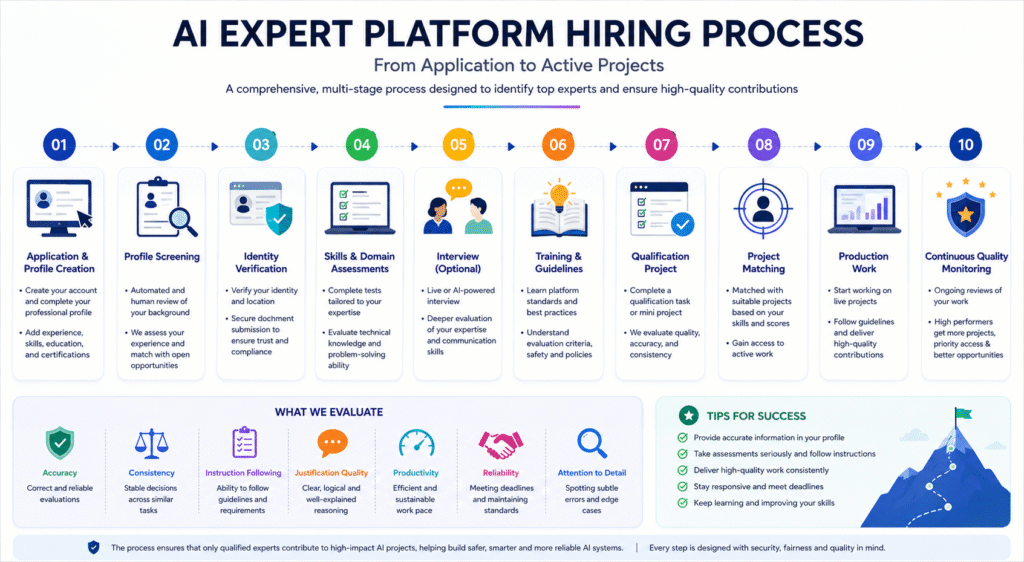
One important distinction is that being accepted by a platform does not necessarily mean immediate access to paid work. Many contributors enter a qualified talent pool and are assigned projects only when their expertise matches current client demand.
Stage 1 — Application and Professional Profile
The hiring journey begins with the creation of a professional profile.
Unlike conventional job applications that focus primarily on employment history, AI expert platforms attempt to understand how your knowledge can improve artificial intelligence systems.
Applicants are typically asked to provide:
- professional experience;
- educational background;
- certifications;
- programming languages;
- technical skills;
- research experience;
- publications (when relevant);
- spoken languages;
- country of residence;
- work authorization.
Some platforms also request:
- LinkedIn profile;
- GitHub portfolio;
- Kaggle profile;
- academic publications;
- personal websites;
- technical blogs.
Rather than filtering candidates solely by years of experience, recruiters often look for evidence that the applicant possesses genuine subject-matter expertise.
For example, a practicing attorney may qualify despite limited AI experience because their legal judgment is more valuable than familiarity with machine learning concepts.
Stage 2 — Resume and Background Screening
Once an application is submitted, the platform evaluates whether the candidate fits current hiring needs.
This screening process may involve both automated systems and human recruiters.
Common evaluation criteria include:
- academic qualifications;
- years of professional experience;
- industry specialization;
- previous AI work;
- technical certifications;
- portfolio quality;
- communication skills.
Some platforms use machine learning models to rank applicants before human review takes place.
These systems analyze resumes for indicators associated with successful contributors.
While the exact algorithms vary, profiles demonstrating clear expertise, measurable achievements and relevant technical skills generally perform better than generic resumes.
Stage 3 — Identity Verification
Before granting access to client projects, most platforms verify contributor identities.
This protects both clients and contributors while helping prevent fraud.
Verification may include:
- government-issued identification;
- facial verification;
- proof of residence;
- tax documentation;
- contractor agreements;
- payment verification.
Platforms working with enterprise clients often have strict compliance requirements related to data privacy and information security.
Stage 4 — Technical and Domain Assessments
This stage usually represents the most significant hurdle.
Rather than asking general interview questions, AI expert platforms evaluate whether candidates can perform the specific tasks required by future projects.
Assessment formats vary considerably.
Coding Assessments
Software engineers may complete:
- algorithmic programming problems;
- debugging exercises;
- system design questions;
- code review tasks;
- performance optimization challenges.
Unlike traditional software interviews, some assessments focus less on finding the fastest algorithm and more on evaluating code quality, readability and reasoning.
Writing Assessments
Professionals working on language models often complete exercises involving:
- grammar;
- editing;
- summarization;
- prompt writing;
- comparative response evaluation.
Reviewers are expected to justify their decisions using structured reasoning rather than subjective preferences.
Domain Expertise Tests
Specialists may receive discipline-specific evaluations.
Examples include:
Healthcare
- reviewing medical recommendations;
- interpreting clinical scenarios;
- identifying unsafe advice.
Law
- contract interpretation;
- legal reasoning;
- jurisdiction-specific analysis.
Finance
- accounting standards;
- investment reasoning;
- financial statement interpretation.
Mathematics
- proofs;
- probability;
- calculus;
- logical reasoning.
These assessments measure not only correctness but also professional judgment.
Stage 5 — AI Reasoning Evaluation
As frontier AI models become increasingly capable, many platforms have introduced assessments specifically focused on reasoning.
Candidates may compare multiple AI-generated responses and answer questions such as:
- Which response demonstrates stronger reasoning?
- Which answer contains unsupported assumptions?
- Which explanation follows the user’s instructions more closely?
- Which response is more helpful?
- Which response introduces factual inaccuracies?
Candidates are expected to justify every decision using detailed written explanations.
This ability to evaluate reasoning has become one of the most valuable skills in AI development.
Stage 6 — Interviews
Not every platform conducts interviews.
When interviews are required, they typically focus less on behavioral questions and more on professional expertise.
Interview formats may include:
Live Technical Interviews
Coding sessions.
Problem solving.
Architecture discussions.
Domain Interviews
Conversation with another subject matter expert.
Discussion of professional scenarios.
Evaluation of industry knowledge.
AI Interviews
Some platforms now use AI-powered interview systems.
These systems evaluate:
- communication clarity;
- reasoning ability;
- consistency;
- problem-solving approach;
- language proficiency.
Although AI may conduct the interview, hiring decisions often combine automated scoring with human review.
Stage 7 — Training and Evaluation Guidelines
Passing assessments does not necessarily mean immediate project access.
Most platforms require contributors to complete mandatory onboarding.
Training often covers:
- evaluation rubrics;
- annotation standards;
- quality expectations;
- confidentiality;
- security policies;
- AI safety principles;
- project workflows.
This stage ensures contributors apply consistent evaluation criteria regardless of personal opinions.
Stage 8 — Qualification Projects
Many contributors begin with smaller qualification tasks.
These projects allow platforms to evaluate real-world performance before granting access to larger assignments.
Performance is assessed across several dimensions.
| Evaluation Metric | Why It Matters |
|---|---|
| Accuracy | Correct evaluations |
| Consistency | Stable decision-making |
| Instruction Following | Ability to respect guidelines |
| Justification Quality | Clear reasoning |
| Productivity | Sustainable work pace |
| Reliability | Meeting deadlines |
| Attention to Detail | Detecting subtle errors |
Qualification projects often function as an extended probation period.
Stage 9 — Project Matching
One of the biggest misconceptions about AI platforms is that contributors choose their own projects.
In reality, most platforms use sophisticated matching systems.
Matching algorithms consider factors such as:
- expertise;
- previous performance;
- assessment scores;
- language proficiency;
- geographic location;
- client requirements;
- availability.
The same contributor may receive completely different projects over time as new client needs emerge.
Stage 10 — Continuous Quality Monitoring
Unlike conventional employment, evaluation does not end after hiring.
AI expert platforms continuously measure contributor performance.
Quality assurance teams regularly review completed work using internal benchmarks.
Common performance indicators include:
- agreement with expert reviewers;
- factual accuracy;
- annotation consistency;
- productivity;
- completion time;
- revision frequency;
- client satisfaction.
Contributors demonstrating consistently high performance may gain access to:
- priority projects;
- premium clients;
- higher-value assignments;
- leadership opportunities;
- reviewer roles.
Conversely, repeated quality issues may result in retraining, reduced project access or removal from specific programs.
Why the Hiring Process Is So Rigorous
Developing advanced AI systems requires enormous volumes of reliable human feedback.
Poor-quality evaluations can introduce errors into training datasets, reduce model performance and ultimately affect millions of end users.
For this reason, AI companies invest heavily in identifying professionals capable of producing consistent, high-quality judgments.
The hiring process is therefore designed not merely to test knowledge, but to assess qualities that are difficult to automate, including:
- analytical reasoning;
- professional judgment;
- attention to detail;
- ethical decision-making;
- communication skills;
- domain expertise;
- consistency over time.
How to Improve Your Chances of Getting Accepted
Although each platform has different requirements, successful applicants tend to share several characteristics:
- A well-structured resume highlighting measurable achievements.
- Demonstrated expertise in a specific domain rather than broad but shallow experience.
- Strong written communication skills, especially the ability to explain reasoning clearly.
- Careful attention to instructions during assessments.
- Consistent performance across qualification tasks.
- Up-to-date professional profiles (such as LinkedIn or GitHub, when relevant).
- Availability to complete onboarding and training promptly.
Candidates who approach assessments as opportunities to demonstrate how they think, rather than simply what they know, are often better positioned for success.
Key Takeaways
The hiring process used by AI expert platforms is fundamentally different from both traditional recruitment and freelance marketplaces.
Rather than hiring contributors solely based on resumes or interviews, these platforms build confidence through multiple layers of assessment, practical evaluation and continuous quality monitoring.
This rigorous approach reflects the growing importance of human expertise in AI development. Every contributor is expected not only to possess deep knowledge in their field but also to apply that knowledge consistently, transparently and at a standard suitable for training the next generation of intelligent systems.
For professionals, understanding this process is more than preparation for an application—it is an opportunity to recognize what AI companies truly value: the ability to think critically, justify decisions and apply expert judgment in ways that improve artificial intelligence.
Countries: Where Can You Work from?
One of the biggest advantages of AI expert platforms is their ability to connect companies with professionals across the globe. Unlike traditional employment, many platforms hire independent contractors remotely, allowing experts to contribute from dozens of countries without relocating.
However, global hiring does not necessarily mean worldwide availability. Eligibility depends on several factors, including local labor regulations, tax compliance, client requirements, language proficiency and data privacy laws.
Before applying, it’s important to verify whether your country is currently supported and whether projects are available for your area of expertise.
Global vs. Regional Hiring
Most AI expert platforms recruit internationally, but they rarely support every country.
Some platforms maintain a broad global network of contributors, while others prioritize specific regions based on client demand.
Common hiring regions include:
- 🇺🇸 North America
- 🇬🇧 United Kingdom
- 🇮🇪 Ireland
- 🇪🇺 European Union
- 🇦🇺 Australia & New Zealand
- 🇸🇬 Singapore
- 🇮🇳 India
- 🇧🇷 Brazil
- 🇲🇽 Latin America (selected countries)
Availability can change over time as platforms expand into new markets or onboard clients with region-specific requirements.
Why Location Matters
Your country of residence can influence more than just eligibility.
Depending on the platform, it may affect:
- available projects;
- hourly compensation;
- payment methods;
- tax documentation;
- identity verification requirements;
- language-specific opportunities.
For example, an English-speaking contributor based in Ireland may qualify for different projects than a Portuguese-speaking contributor in Brazil, even if both have similar professional backgrounds.
Language Can Be an Advantage
Many AI models are now trained and evaluated in multiple languages, creating opportunities for bilingual and multilingual professionals.
In addition to English, platforms frequently recruit experts in languages such as:
- Spanish
- Portuguese
- French
- German
- Italian
- Japanese
- Korean
- Chinese
- Arabic
- Hindi
Native or near-native fluency is often preferred for language evaluation, localization and translation projects.
Always Check Platform Requirements
Eligibility policies change as platforms grow and client needs evolve. Before investing time in assessments or interviews, review each platform’s current hiring requirements, supported countries and contractor policies.
If your country is not currently supported, you may still be able to join a waiting list or become eligible when new projects expand into your region.
Tip: If you’re eligible for multiple AI expert platforms, consider creating profiles on more than one. Since project availability varies over time, diversifying across platforms can improve your chances of maintaining a steady flow of work.
Final Recommendations
Artificial intelligence is transforming not only how software is built, but also how expertise is valued. As AI systems become more capable, the need for qualified professionals who can evaluate, verify and improve their outputs continues to grow.
AI expert platforms have emerged as the bridge between organizations developing frontier AI models and professionals with specialized knowledge. Whether your background is in software engineering, healthcare, law, finance, education or another field, these platforms provide new ways to apply your expertise in one of the fastest-growing sectors of the global technology economy.
If you’re considering joining an AI expert platform, keep these recommendations in mind:
- Choose platforms aligned with your professional expertise, not just the highest advertised pay.
- Invest time in assessments and onboarding, as they often determine access to higher-quality projects.
- Maintain profiles on multiple platforms to increase your chances of receiving consistent work.
- Stay current in your field, as domain expertise is one of the most valuable assets in AI development.
- Approach AI work as a long-term opportunity, where reliability, analytical thinking and professional judgment are often rewarded more than speed alone.
As the AI workforce continues to evolve, demand for high-quality human expertise is expected to expand across industries. Professionals who combine deep subject knowledge with strong reasoning and communication skills will be well positioned to contribute to the next generation of intelligent systems.
This guide provides a broad overview of the AI expert ecosystem, but every platform has its own hiring process, compensation model and project types. Before applying, it’s worth exploring each platform in more detail.
Continue your research with our in-depth reviews:
- Outlier Review
- Mercor Review
- Micro1 Review
- Alignerr Review
- Scale AI Review
- Turing Review
- Invisible Technologies Review
By understanding how these platforms differ and where your skills fit best, you’ll be better equipped to navigate the rapidly expanding AI workforce and identify opportunities that align with your expertise and career goals.

Webstudio AI
We are a team passionate about technology, artificial intelligence, automation and building smart web solutions. We combine technical expertise, creativity and curiosity to explore the latest innovations in the digital world. Our mission is to transform ideas into practical, accessible and inspiring experiences by sharing tools and insights that help people and businesses grow through intelligent technology.